Guide for First Time Game Masters Part 2, Understanding The System
A TableTop RolePlaying Game (TTPRG) is a narrative-driven storytelling game that revolves around a group of players who all play characters they have created. The rules of the TTRPG chiefly govern how players can affect the world around them, and how characters accomplish their goals.
The world around these characters is crafted by the arbiter of the game, the Game Master. They describe initial conditions, play any Non-Player Characters (NPC), manage combat, and detail the consequences of players’ actions. Having to create an entire world and decide “What happens next” makes being a Game Master the most critical role for the success of a game, and also the hardest to pull off. Thus, taking on the role of the Game Master can feel daunting.
This is a detailed guide on how to approach running your first TTRPG as a Game Master. Using one of the most popular TTRPGs on the market, Dungeons and Dragons, as an example, I will advise on what information you need to have before you start to prepare a successful adventure, how to prepare your game to its fullest while leaving room for your players’ creativity, and how to conduct your players through the story you have crafted.
The final goal of any TTRPG is that everyone at the table, including the Game Master, has fun. These guidelines and ideas will support you in facilitating an experience that both you and your players will enjoy, leaving both sides hungry for more. Following these guidelines will instill you with some good Game Master habits and provide skills to build on for your future games.
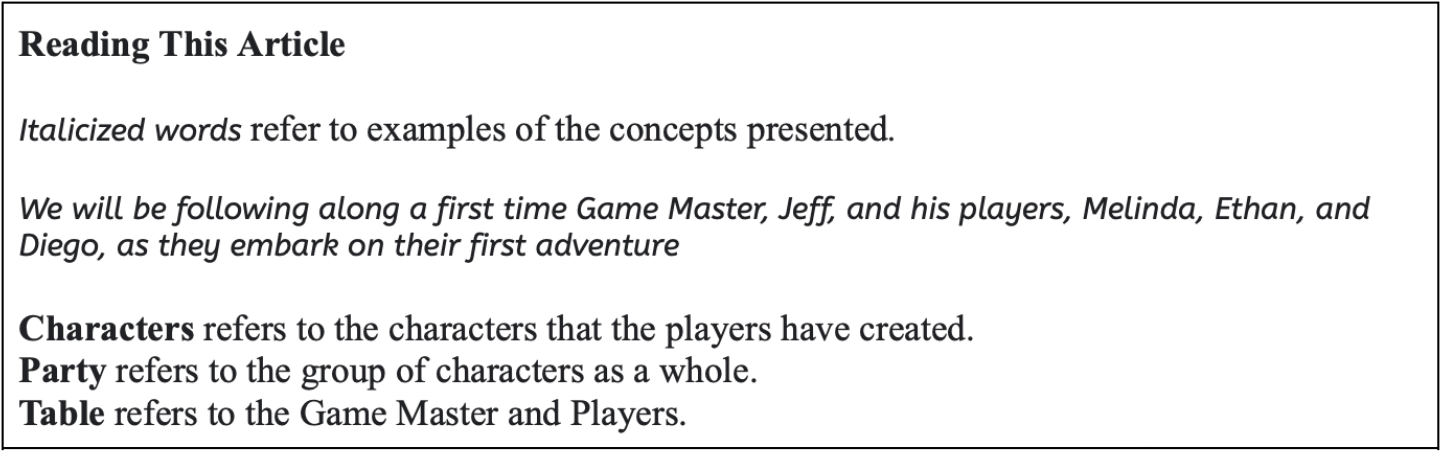
This is the second part of the series, focusing on what you need to understand from the written rules of your system, and how you can use your understanding to create the most memorable exprience possible. “System” here simply refers to the specific TTRPG you are playing, such as Dungeons and Dragons.
The Rules
It is integral that the Game Master has an understanding of the rules, especially if there are players new to the hobby. Because you as the Game Master are in control of the game, your players will first and foremost look to you for clarifications on how the rules of a system work and what they are supposed to do.
For players who have not played the system, it is often the Game Master’s responsibility to teach them the rules. To this end, you should have a short elevator pitch memorized which summarizes how the rules work to a new player so that they can start playing as soon as possible.
For Dungeons and Dragons, an elevator pitch might be: “You take most actions in the game by telling the DM what you want your character to do (‘I bash open the door’). If the Game Master asks for a roll, you roll a twenty-sided die. You then add the relevant modifier from your character sheet (When the Game Master asks for a Strength roll, you add your strength modifier). The Game Master will then tell you if your character fails or succeeds and narrate what happens as a result.”
However, being the master of a game’s rules does not mean that you have to follow them word-for-word. The primary objective of playing TTRPGs is to have fun, and overzealous adherence to the written rules can be a damper. In situations where rules of the system are unclear or where a player thinks they have misapplied them, always err in the favor of what creates a more interesting story and facilitates the flow of the game. As the Game Master, you ultimately have the power to decide what happens. However, if a rule clarification is needed, you can always assign a player to find the necessary rule from the rulebook, and move on in the meantime.
The Tone of the Rules
The rules dictate how your players can affect the world through their characters. Therefore, adding new rules or changing existing ones can be a great tool to change the mood and feel of your setting and game. Rules also define how powerful characters are in relation to the world around them, and this changes the feel of the game greatly.
Jeff hears that both Ethan and Melinda want a game where they will have to make difficult choices when faced with unforgiving conditions. He realizes that having limited resources often forces players to make difficult decisions. Therefore, Jeff decides to add rules for food and water to the setting. Dungeons and Dragons has a mechanic where characters can rest to replenish their resources and health. Jeff decides to add a rule that resting is only allowed if they have sufficient food. Jeff also decides to ban spells that magically create food from the game. Finally, Jeff decides to limit his players to creating low level characters. Having characters of a lower level will give the players a feeling of powerlessness. In addition, creating low level characters is much more straightforward than high level characters and this will facilitate character creation.
If you undestand how the rules scaffold the intended experience of the game, you can utilize these mechanics to amplify these experiences. The more you lean into the theme and intention of the rules, the more the gameplay and narrative of your game will meld and flow. You can also use the mechanics as a guiding hand, incentivizing players to do certain through mechanical advantages or disadvantages.
For his apocalyptic game, Jeff wants the playes to approach situations with caution and planning. He understands that he main fail state in Dungeons and Dragons occurs when a character is reduced to 0 hit points and falls unconscious. These setbacks can be offset with healing spells, which increase a character’s hit points. However, if players know that they can rely on healing spells, they know that their mistakes do not matter as much. Jeff chooses to change healing spells into a more costly action in order to incentivize players to plan their usage. In his updated ruleset, healing spells are cast on one turn and, instead of taking effect immediately, they take effect at the beginning of the caster’s next turn. This incentivizes players to only use healing when they know they are in a safe situation, rewarding planning and caution.