Guide for First Time Game Masters Part 4, Preparing the Narrative
With a thorough understanding of your players, the system, and the characters, you can begin preparing the events that will take place in your game.
While TTRPGs are often played in a longer-term campaign spanning months, they can also be played as shorter adventures, including ones that only last one session, or from two to four hours. Single session adventures are called One-Shots. This guide focuses on advising you on how to craft a short adventure. I recommend a shorter adventure as your first foray in the world of TTRPGs, as it is non-committal and much easier to prepare.
The Goal
In TTRPGs the main question you ask your players is “What do you do?” This can be overwhelming, especially for less experienced players. It is important that you,as the Game Master, have a clear goal in mind for your characters to pursue (“Liberate the Town,” “Pull off the heist,” “Deduce the true culprit”). This will support your players with a clear indication of what to do next, driving the adventure without constricting their decision making.
Wanting to make survival a relevant concern in his game Jeff wants the adventure to be a grueling journey. He wants Melinda’s sister to be key to the plot, and also wants to tie in the theme of hope. Ultimately, he decides that Melinda’s sister revealed that she had found a way to a better land to escape the disaster known as the rot, and that she has been kidnapped by a band of raiders.
Sandbox vs. Railroad
The eternal dilemma of game preparation is how open-ended to make your adventure. Players enjoy the freedom for their characters to roam and explore, interact with other players characters and find various ways to approach and solve their problems. However, the Game Master cannot be prepared for every course of action that the players might take and can only have certain parts of the game prepared. This dilemma is often summarized as trying to find the balance between a campaign that gives the players unlimited freedom (sandbox) and gameplay that forces players onto a strictly linear track of events (railroad).
For your first time being a Game Master, and especially if your players are not very experienced players, you should opt for a more linear narrative, in the railroad style. This will support you in moving the campaign forward and keeping your players on track. A more open-ended campaign carries the risk of generating many loose ends that are hard to keep track of and bring to a neat conclusion.
The Flowchart
Once you have your goal, the next step is to build a scaffold for your adventure. This consists of identifying important elements, and connecting them into a cohesive but flexible narrative. Important elements are plot points or parts of the game you want your table to engage with. Figure out how each one will contribute to your players reaching the goal, and what will drive players to progress from one to the other. Your short adventure should include probably no more than 7 elements, so that you can focus on making each one an impactful experience.
I will first detail on how to create your elements individually, and then I will give an example of how to link them into a flowchart. Advice is given below on five different types of elements:
Locations:
Your locations should be impactful, unique, and flavorful. They should encourage your players to pay attention to their new environment and consider how being there might change their character’s actions. To best achieve this, write out descriptions of the location, or just jot down a few details and words you can use to describe it. If you intend for your players to interact with this environment, make sure to plan specific facets of the location that can be interacted with, and then point your players toward these facets in your descriptions.
The characters eventually will end up in a hostile bog, in which they will have to track down a raider camp. Jeff jots down some basic description of the location, such as “Putrid” and “Foul,” he makes sure to include details about the long vines and pools of quicksand that cover the area, suggesting that his players can swing along these vines to avoid danger. The raider camp itself is surrounded with a perimeter of druidic artifacts displayed on pikes, and the camp itself is centered on a circle of standing stones. This environmental storytelling relays the fact that the raiders took this camp from a druidic commune, suggesting that Diego, as a druid character, could still commune with the standing stones and tip the battle in their favour.
Non Player Characters:
NPCs are the main touchstones that your players’ characters have to the world. NPCs are how you communicate information, and they are often the main forces assisting or opposing the characters. You can outline everything you need to write an interesting NPC quickly by focusing on five core traits: their Description, Voice, Capabilities, Information, and Motivation.
Jeff wants to include a cranky but lovable character for Ethan to interact with. He chooses to add in a conniving Goblin opportunist that tries to steal the party’s things.
-
Physicality is a simple physical description of this person. Include features that stand out to the player characters and that convey something about the NPC at a glance, allowing your players to visualize them. Warner the goblin is a small, squat-nosed figure, dressed in what may once have been fine clothing but which has now worn to rags. His hair is matted, his large eyes bulge out of his head, darting around greedily. He prominently carries a knife.
-
Voice is how you, the Game Master, talk when you portray the NPC. This does not have to be an identifiable accent or uncomfortable pitch, it can just be something about their pattern of speech that makes them memorable and identifiable. Jeff practices Warner’s voice, giving him a flat, nasal voice to show him as a small grubby individual.
-
Capabilities is how powerful the NPC is, and what they can do to affect the characters and the world around them. Some NPCs are incredibly powerful, being able to crush the characters with brute strength or wielding enough influence to land them in prison with the wave of a hand. But this does not define the NPC’s importance. Even smaller NPCs can affect the story and characters, even if that just means giving them a smile and a wave when they’re at their lowest. While Warner is not a formidable force in face to face combat, he can become a useful and versatile ally if the party convinces him to side with them against the raiders.
-
Information is what this NPC knows. It is useful for the Game Master to have a record of what a character knows to make sure they have realistic reactions and do not end up breaking immersion and dumping information about the setting on the characters. This trait is especially important for games that center around solving mysteries and information gathering. Warner knows a shortcut through the aforementioned bog, and can make traversal a lot easier. He also sometimes does favors for the raiders, meaning he knows a lot about the layout of their camp.
-
Motivation: Finally, every NPC you create should have a motivation. NPCs should have something they want, and which they are currently trying to obtain. This does not necessarily have to be directly connected to the adventure, but is integral in making the world seem alive. Warner was once a noble of the goblin court, but has been forced to leave this life behind. Ultimately, what he wants is enough money and status in the wasteland to return to some modicum of respectability. This is a key piece of information, as it informs Jeff on how Warner might react positively to flattery but negatively to intimidation.
-
Obstacles are the things that the player characters must overcome in order to attain their goals. As you design obstacles, leave room for creative solutions to them that you had not anticipated. A lot of the fun of a TTRPG for the players comes from being able to approach problems in novel ways. When you leave room for this and not force your characters into one method of solving a problem, the adventure becomes much more interesting for all involved. The raider camp is an obstacle that the players must engage with, since Melinda’s sister is being held captive there. They are free to simply attack the raider camp (under cover of night or in the daylight), try to sneakily extract Melinda’s sister, use the circle of magical stones in the bog to summon allies, use Warner’s connections to fool their way in, and whatever else the characters might come up with.
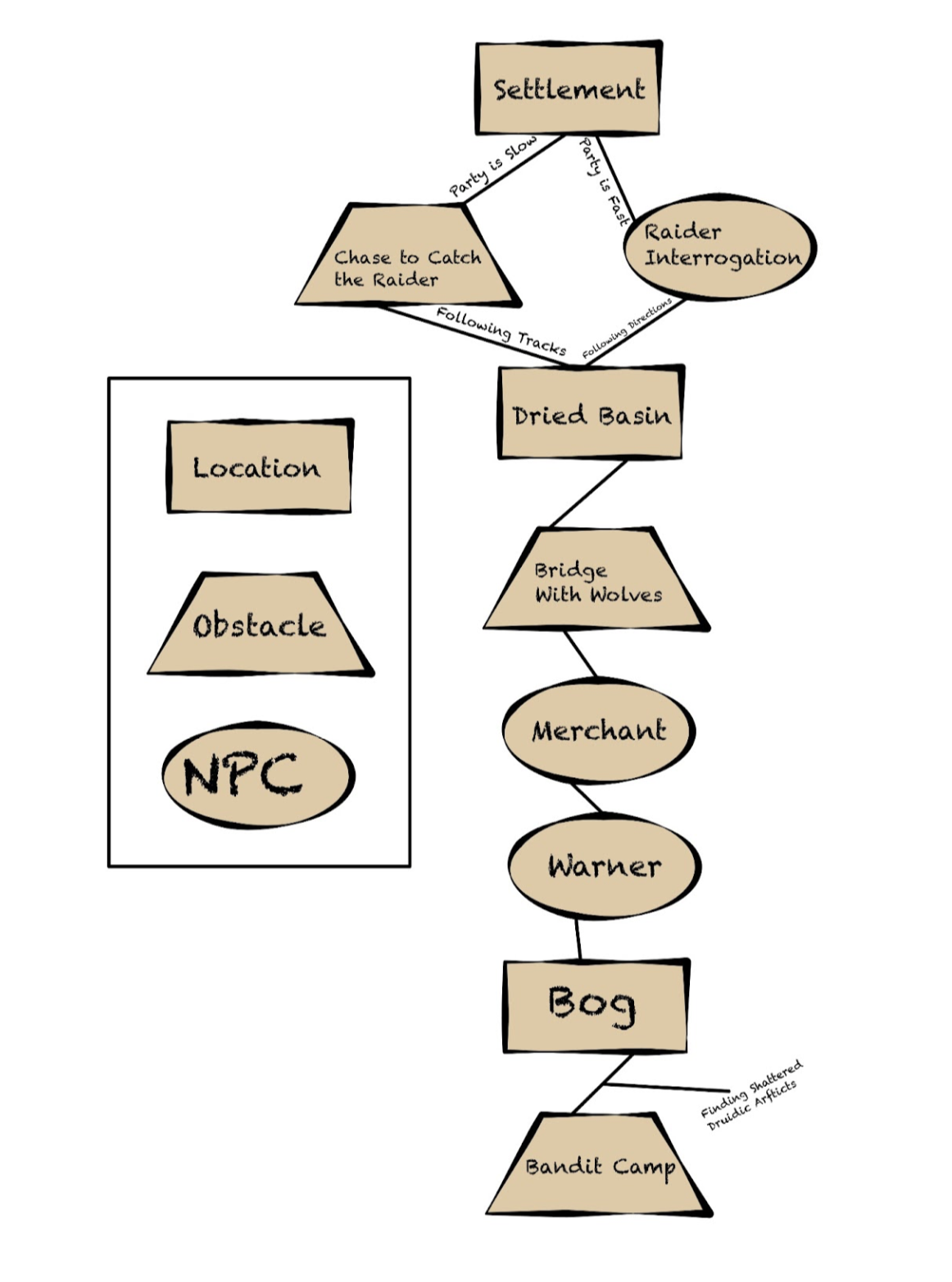
After outlining some elements for your game, it is time to connect them into a flowchart. Think about what would lead your players from one to the other, and how the knowledge and experiences they will have gained from one would affect their choices in the next one.
Jeff starts creating the flowchart for the adventure. He knows that he wants to have the final obstacle be the raider camp, and that he wants Warner to come and try to steal something critical from the characters in between. He also wants to include locations of the bog, a hardy survivor settlement, and a dried basin. He fits in two short combats for Melinda and includes a difficult moral choice in the form of a merchant the characters might be forced to rob.